
Skip to content
  • IPÊ
    • Sobre o IPÊ
    • Missão
    • Nosso Credo
    • Governança
    • Estratégias
    • Apoiadores e Parceiros
    • Prêmios
    • Imprensa
    • Ipeanos
    • Onde Estamos
    • Nossos Resultados
    • Relatórios Anuais
    • Seja nosso Parceiro
  • Doe Agora
    • Doe Florestas
    • Por que doar?
    • Arredonde Suas Compras
    • Doe com PayPal ou Conta Corrente
    • Doações internacionais
    • Adote uma Espécie
    • Proteja o Sistema Cantareira
  • Notícias
    • Últimas Notícias
  • Projetos
    • Baixo Rio Negro
    • Nazaré Paulista
    • Pantanal e Cerrado
    • Sul da Bahia
    • Pontal do Paranapanema
    • Projetos Temáticos
      • Voluntariado para Conservação
      • Pesquisa e Desenvolvimento / P&D
      • Áreas Protegidas
      • Integração Escola e Comunidade
      • Projeto Escolas Climáticas
      • Paisagens climáticas
      • Centro de Educação e Cooperação Socioambiental para o Clima
      • Fábrica de Soluções
      • Territórios da Vida Silvestre
  • Negócios Sustentáveis
    • Marketing Relacionado a Causas
    • Cases de MRC
    • Modelos de Parcerias
    • Iniciativas para Doação
  • Soluções em Educação
    • Escas
    • Mestrado Profissional
    • Pós-graduação
    • Cursos de Curta Duração
  • Publicações
    • Flora Regional
    • Boas Práticas em UCs
    • Atlas Cantareira
    • Artigos Científicos
    • Séries Técnicas, Guias e Outros Materiais
  • Estatuto
  • Código de Ética
  • Parcerias Públicas
  • Fale Conosco
Terceiro encontro do Projeto Juntos pelo Pantanal

The United for Pantanal (Juntos pelo Pantanal) project concludes its training cycle with community brigades advancing in the prevention and fight against forest fires

30 de July de 2025 by Carol Campos

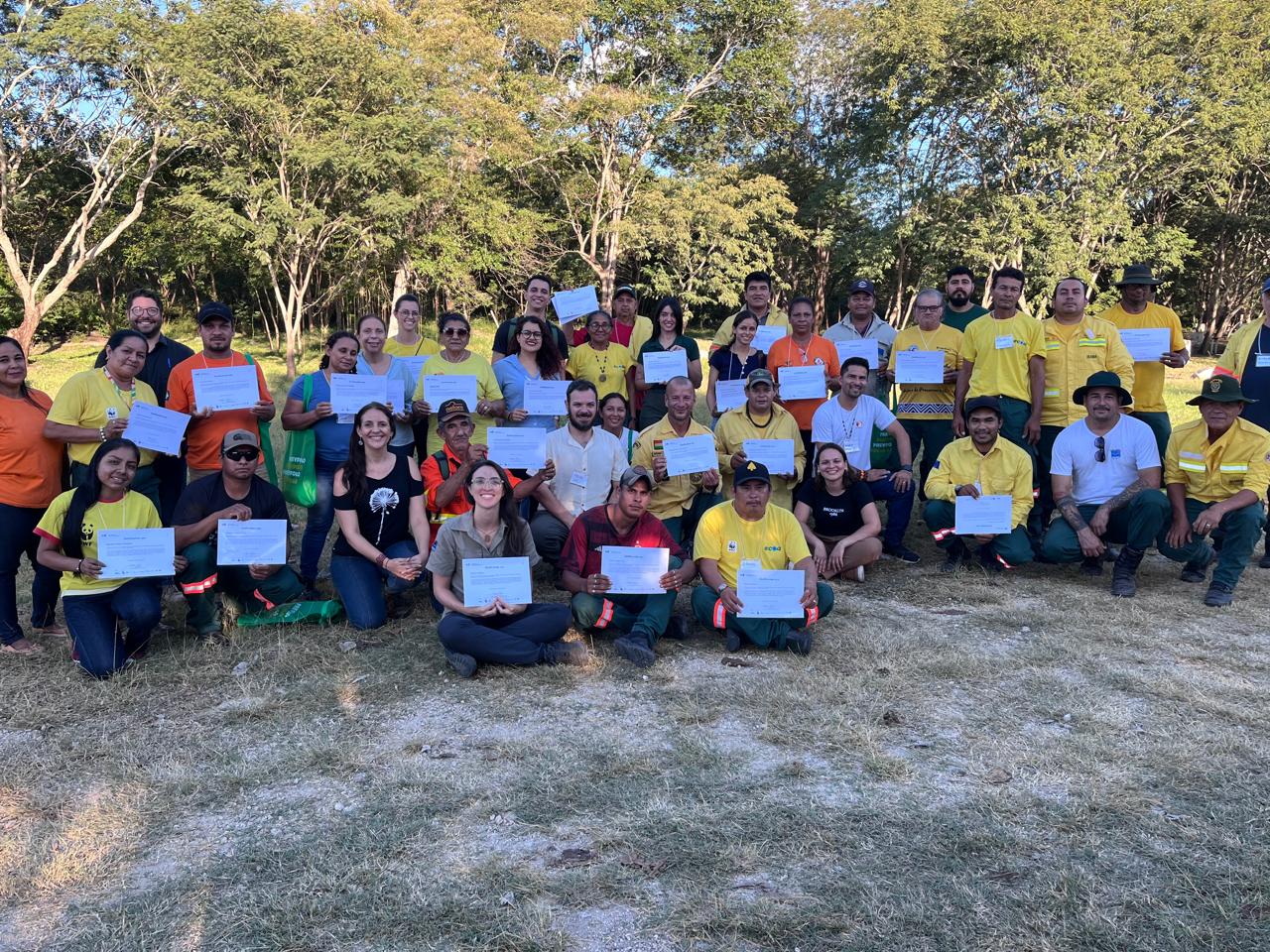
To support the work of community brigades in the Pantanal, the project United for Pantanal: strengthening voluntary and community participation in Integrated Fire Management carried out training with community brigades in the Pantanal of Mato Grosso do Sul between May 13th and 15th, in the Municipal Environmental Protection Area (APA) Baía Negra, in Ladário/MS.

Two preparatory events preceded the training. The first workshop, which assessed the performance of these brigades, took place in February. The second workshop, which focused on planning Integrated Fire Management (IFM) activities, took place in March. Last week’s meeting brought together 44 representatives from 13 community brigades in the region, as well as professionals from 10 public and private institutions working with IFM in the Pantanal.

“Our work in the Pantanal is to gather more information about community fire brigades, expand the articulation of these initiatives with public authorities such as Ibama, ICMBio, and the Fire Department, and work primarily to strengthen prevention efforts. It’s crucial that community fire brigades are better prepared to respond to forest fires near or within their communities, so they can work safely and collaboratively, improving conservation outcomes,” explains Angela Pellin, project coordinator at IPÊ, leading United for Pantanal.

Drive key application simulation

In this third meeting, participants carried out a simulation of the application of the activation key built collectively with the community brigades and other institutions that deal with Integrated Fire Management in the Pantanal, as well as training in the use of applications for monitoring hotspots and sharing geographic information for precise location and reporting of incidents.

André Luis Siqueira, Director of Programs and Projects at ECOA, says that since 2006, he has seen volunteer and community brigades as a strategy to reduce and transform the impacts caused by fires each year within the biome. “Through the federal strategy, IPÊ was already discussing volunteer and community brigades as a public policy. We monitored and became involved in this process, which is now consolidating in practice. The United for Pantanal Project brought a new level of discussion regarding the brigades. Beyond the focus on emergency responses we’ve been working on, providing equipment and training so the brigades could defend their territories more efficiently and safely, the project took this discussion to a new level, creating deeper insights, universalizing information, defining key triggers, bringing institutions together, and expanding actions.”

For Leonida Souza, leader of the Barra de São Lourenço Community Brigade, participating in the training helped establish goals and strategies to defend not only the community but also all the biodiversity present in the biome. “As a brigade, we’re not just protecting our lives, but an entire ecosystem, which is our Pantanal. “I can’t even express how important the Pantanal is to our lives, because it’s not just animals, water, and people; it’s also full of life. We live within the Paraguai River Basin, so the fact that we’re a brigade to protect this place is something that moves me deeply.”

Incident Command System

Thainan Bornato, an environmental technician with Prevfogo/IBAMA in Corumbá, Mato Grosso do Sul, emphasizes that technology and environmental education training are essential to improving the effectiveness of firefighting efforts. “Community fire brigades can prevent fires from becoming large-scale and making it more difficult to fight them. Having trained people to take part in prevention, so they can talk to community members and make that initial identification, we ensure that fires are smaller and less aggressive.”

João Paulo Pereira Santos Júnior, a sergeant in the Mato Grosso do Sul Fire Department, emphasizes the importance of training like this to improve integration between community brigades and other institutions involved in fighting forest fires. “Community brigades are the ones who know the area, know the terrain best, and are often the first to arrive on the scene, carrying out the first firefight or informing Ibama/Prevfogo or the Fire Department about the need for resources and support.”

PSA Brigades

At the event’s closing, legal, management, and fundraising aspects for these groups were presented, enabling them to participate in decision-making and fundraising. Finally, Letícia Walter, a civil servant from the State Secretariat of Environment, Development, Science, Technology, and Innovation (SEMADESC), presented the call for proposals for Payment for Environmental Services for fire brigades. According to Letícia, “PSA Brigades aims to foster the establishment of local brigades in areas of the Pantanal of Mato Grosso do Sul that are highly susceptible to fire, integrating preventive, educational, and first response actions. We identified the need to support shared governance of fires in the Southern Pantanal by focusing on those who actually work in the area.”

Next steps

The next step of the project will be to consolidate the information gathered throughout the project and provide feedback to participants. By the end of June, the project will donate equipment to community fire brigades, including Personal Protective Equipment (PPE) and tools for fighting wildfires, such as fire extinguishers, blowers, and backpack pumps. The selected brigades will be selected by IPÊ and project partners based on the information gathered throughout the process.

The Juntos pelo Pantanal project is implemented by IPÊ – Institute of Ecological Research, in partnership with Ibama/Prevfogo, ICMBio – CMIF, Fundo Casa Socioambiental (Socio-Environmental House Fund), and ECOA (Ecology and Action). Funding is provided by the Global Environment Facility (GEF) under the Conservation, Restoration, and Management Strategies for the Biodiversity of the Caatinga, Pampa, and Pantanal Project (GEF Terrestre). This project is coordinated by the Ministry of Environment and Climate Change (MMA), with the Inter-American Development Bank (IDB) as the implementing agency and the Brazilian Biodiversity Fund (FUNBIO) as the executing agency.

Categories News Tags brigades, climate change, fires, Pantanal
Escolas Agroecológicas que integram o Centro de Educação e Cooperação Socioambiental para o Clima
Why strengthening family farming is strategic for society, biodiversity and the planet?

Leave a Comment Cancel reply

Posts Recentes

  • IPÊ inaugura nova sede em Manaus/AM 
  • Projeto fortalece o manejo de castanha-da-amazônia na Flona de Caxiuanã, no Pará
  • Oportunidade: Seleção de Pessoa Jurídica para desenvolvimento de cadeias da sociobiodiversidade na Chapada do Araripe (CE) 
  • Comunitário da RDS Puranga Conquista participa de evento nacional de Restauração Ecológica em Brasília
  • Cartilha sobre meliponicultura do Projeto Agroecologia em Rede é premiada em Congresso Amazonense de Meliponicultura 

Publicações

  • August 2026
  • July 2026
  • June 2026
  • May 2026
  • April 2026
  • March 2026
  • February 2026
  • January 2026
  • December 2025
  • November 2025
  • October 2025
  • September 2025
  • August 2025
  • July 2025
  • June 2025
  • May 2025
  • April 2025
  • March 2025
  • February 2025
  • January 2025
  • December 2024
  • November 2024
  • October 2024
  • September 2024
  • August 2024
  • July 2024
  • June 2024
  • May 2024
  • April 2024
  • March 2024
  • February 2024
  • January 2024
  • December 2023
  • November 2023
  • October 2023
  • September 2023
  • August 2023
  • July 2023
  • June 2023
  • May 2023
  • April 2023
  • March 2023
  • February 2023
  • January 2023
  • December 2022
  • November 2022
  • October 2022
  • September 2022
  • August 2022
  • July 2022
  • June 2022
  • May 2022
  • April 2022
  • March 2022
  • February 2022
  • January 2022
  • December 2021
  • November 2021
  • October 2021
  • September 2021
  • August 2021
  • July 2021
  • June 2021
  • May 2021
  • April 2021
  • March 2021
  • February 2021
  • January 2021
  • December 2020
  • November 2020
  • October 2020
  • September 2020
  • August 2020
  • July 2020
  • June 2020
  • May 2020
  • April 2020
  • March 2020
  • February 2020
  • January 2020
  • December 2019
  • November 2019
  • October 2019
  • September 2019
  • August 2019
  • July 2019
  • June 2019
  • May 2019
  • April 2019
  • March 2019
  • February 2019
  • January 2019
  • December 2018
  • November 2018
  • October 2018
  • September 2018
  • August 2018
  • July 2018
  • June 2018
  • May 2018
  • April 2018
  • March 2018
  • February 2018
  • January 2018
  • December 2017
  • November 2017
  • October 2017
  • September 2017
  • August 2017
  • July 2017
  • June 2017
  • May 2017
  • April 2017
  • March 2017
  • February 2017
  • January 2017
  • December 2016
  • November 2016
  • October 2016
  • September 2016
  • August 2016
  • July 2016
  • June 2016
  • May 2016
  • January 2016
  • December 2015
  • November 2015
  • October 2015
  • September 2015
  • August 2015
  • July 2015
  • June 2015
  • May 2015
  • April 2015
  • March 2015
  • February 2015
  • January 2015
  • December 2014
  • November 2014
  • October 2014
  • September 2014
  • August 2014
  • July 2014
  • June 2014
  • May 2014
  • April 2014
  • March 2014
  • February 2014
  • January 2014
  • December 2013
  • November 2013
  • October 2013
  • September 2013
  • July 2013
  • June 2013
  • May 2013

Categorias

  • Annual Reports
  • Áreas Protegidas
  • Baixo Rio Negro
  • Boas Práticas
  • Cases de MRC
  • Centro de Educação e Cooperação Socioambiental para o Clima
  • COP-16 Agenda
  • COP16
  • COP30
  • Cursos
  • Depoimentos
  • Doe
  • Donate
  • Home
  • Home
  • Iniciativas para Doação
  • IPÊ
  • IPÊ
  • IPÊ
  • IPE
  • ipe em movimento
  • Não categorizado
  • Negócios Sustentáveis
  • News
  • Notícias
  • Paisagens Climáticas
  • Pesquisa e Desenvolvimento
  • Pontal do Paranapanema
  • Projetos
  • Projetos Temáticos
  • publicacoes
  • publicacoes
  • ra.2022
  • Relatórios Anuais
  • Thematic Projects
  • Uncategorised
A implementação do kmspico em sistemas educacionais ou corporativos permite uma utilização mais racional dos recursos e apoia iniciativas de proteção ambiental. Você pode download ativador kmspico com segurança agora mesmo.

Onde Estamos

Rod. Dom Pedro I, km 47
Nazaré Paulista, SP, Brasil
Caixa Postal 47 – 12964-022
Tel: (11) 3590-0041

Mapa para o IPÊ
Escritórios
Ouvidoria

Redes Sociais

  • Facebook
  • Twitter
  • Instagram
  • Youtube
  • Linkedin

Política de Privacidade
Programa de Privacidade
Políticas de Cookies

Termos de Uso | Estatuto
Copyright © Ipê – Instituto de Pesquisas Ecológicas.
Email: ipe@ipe.org.br

kraken onion kraken darknet kraken tor
A implementação do kmspico sistemas educacionais ou corporativos permite uma utilização racional dos recursos e apoia iniciativas de proteção ambiental Você pode download ativador kmspico com segurança agora mesmo kmspico.lc.