
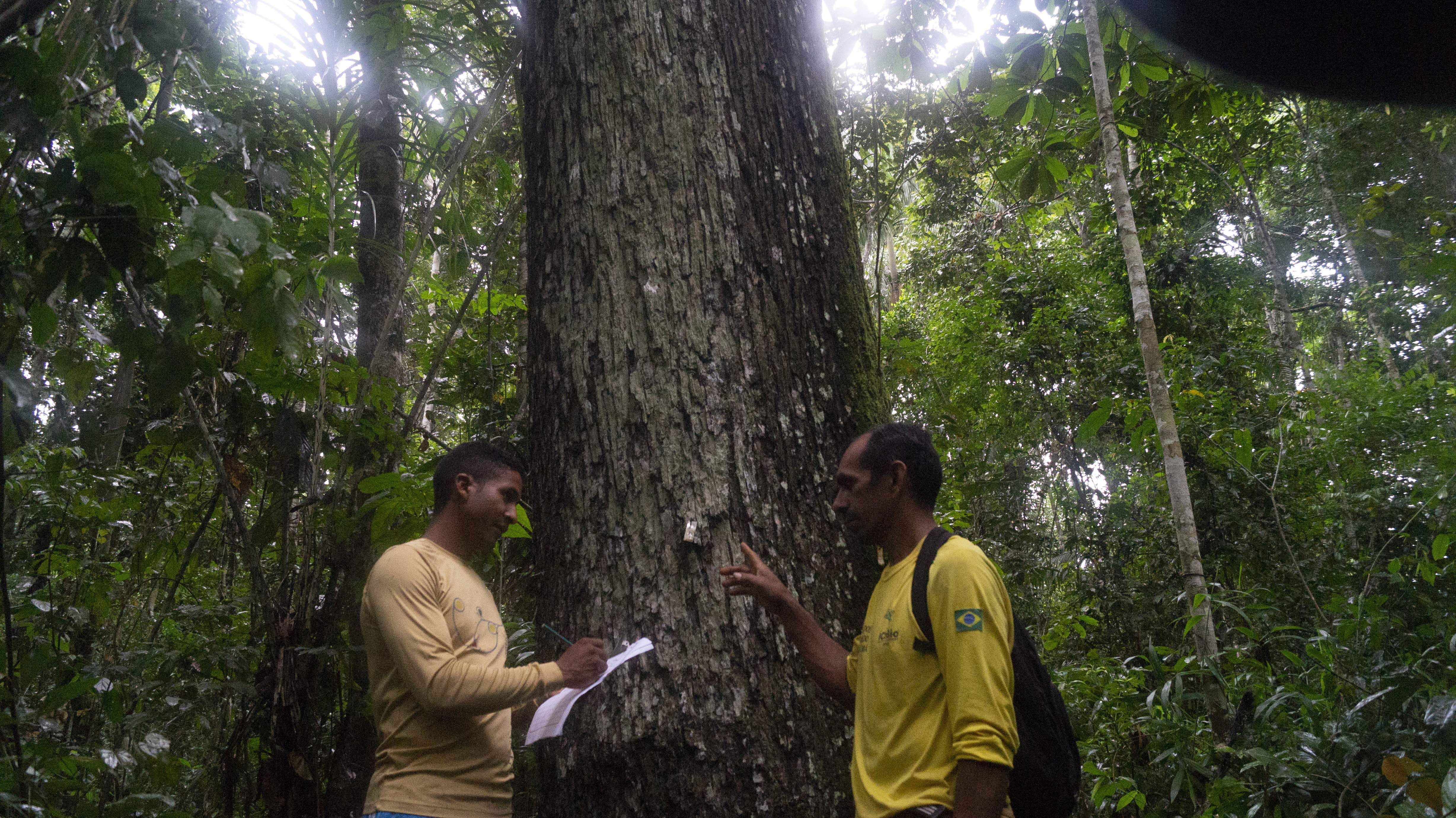
Training for sustainable income-generating activities, training people in agro-ecological production, activities to strengthen the management of protected areas, the development of production chains, and research into species of fauna, among others, are all activities carried out by IPÊ in its almost 20 years of presence in the Amazon. IPÊ’s efforts in the Amazon have benefited more than 5,000 people, with projects that prioritize social participation and respect for local traditions.
 The Institute began its work to protect the biome in the lower Rio Negro region, in the state of Amazonas, with the challenge of implementing territorial management models that would contribute to improving quality of life and conserving biodiversity. There, in the first few years, it promoted partnerships with various sectors, implemented educational work through the Maíra I boat, and developed actions that benefited more than a thousand people in 29 communities, creating income alternatives for families in rural Manaus, with a focus on developing production chains (with sustainable agriculture), community-based tourism and handicrafts. IPÊ supported the formalization and strengthening of local organizations, with documentation for access to public policies aimed at family farmers and artisans, and contributed to business infrastructure, such as the restaurant in the Nova Esperança community and the processing structure of a women’s group and a network of farmers. It also supported the formation of an agroecology network in Amazonas, made up of representatives from various institutions and farmers’ groups in the state (Maniva Agroecology Network).
 Celio Arago (photo), a craftsman from the lower Rio Negro, was one of those who benefited from the Institute’s projects. Workshops, courses and exchanges have enabled him to further develop his skills as a craftsman, a trade he learned from his father. From the Nova Esperança community, Celio’s pieces have taken the world by storm and been nominated for awards. After the project, Celio now teaches young people what he has learned. “The experience I’ve had with IPÊ has opened many doors for me. Now I teach young people in my community so that they have the same chance as me.”
In the region, IPÊ has also worked for the conservation of the Amazonian manatee and the collared saium, with scientific field research and social integration and educational activities. The results of the work are shared with organizations to support the construction of public policies for wildlife.
Evolution towards Integrated Conservation Solutions for the biome
Over the years, the challenges have grown, as have the possibilities for positive transformation in the biome, through Conservation Units (CUs). In partnership with the Chico Mendes Institute for Biodiversity Conservation (ICMBio), since 2012 IPÊ has been developing two projects of great importance in federal PAs: Motivation and Success in Conservation of PAs – MOSUC (with support from the Gordon and Betty Moore Foundation), and Participatory Monitoring of Biodiversity – MPB, (with support from USAID, the Gordon and Betty Moore Foundation and the ARPA Program). They are looking for innovative and integrated solutions between various sectors to support the consolidation of 42 PAs, a territory of approximately 35 million hectares – an area larger than the states of São Paulo, Rio de Janeiro and Espírito Santo combined.
The MOSUC project was born to increase community participation in management, overcome the difficulties of financial resources and act to transform the Amazon’s PAs into regional development hubs. The work benefits 30 PAs in 6 states, involving managers, organizations and communities to work together to protect national parks, extractive reserves, national forests and other protected areas. This pioneering action by IPÊ and ICMBio helped and promoted partnerships with 12 local institutions that hired 54 employees to work in the PAs of Acre, Roraima, Rondônia, Pará, Amapá and Mato Grosso.
The support of these professionals has brought benefits to the PAs, as Aldeci Cerqueira (Nenzinho), from the association of the Cazumbá-Iracema Extractive Reserve (Resex) (Acre), reports. “The project has given us the opportunity to get closer to ICMBio, the unit’s managing body, by working in an integrated way. It’s been very important for me. The Association was already working with ICMBio, but with a reduced team, we found it difficult to reach the communities. This integrated management (with the arrival of hired technicians) provides better service to the communities,” he says. The work with local institutions has generated employment and income in the communities involved with the PAs, and has contributed to increasing the community’s ties with the units and strengthening the organizational structure of local institutions that already have some relationship with the PA. Today, for example, the newest ICMBio manager for the Resex Cazumbá Iracema is a resident trained by MOSUC.
Find out more about MOSUC: https://www.ipe.org.br/ra2019/projetos/mosuc.html
 In Participatory Biodiversity Monitoring in Amazon Conservation Units (MPB), the community is the main agent of transformation. The aim is to gather information together and exchange knowledge between researchers, managers and residents of the PAs and their surroundings about the importance of local biodiversity and how they themselves can contribute to protecting it through monitoring. The project is part of ICMBio’s Monitora Program, which seeks to strengthen the dialogue around environmental issues, based on sharing information and formulating questions, jointly creating protocols for biodiversity surveys.
The MPB project has already gathered a lot of information in the areas monitored from 2014 to 2018. The data is used for scientific research into species, improving knowledge of biodiversity and sustainable management of forest assets. These surveys, in turn, contribute to planning and improving the management of these protected areas and to combating climate change, species extinction, deforestation and poverty.
“The surveys are very important, but the work goes far beyond the knowledge gathered, as it also involves the participation of local populations in the management of protected areas. Therefore, the project is fundamental to achieving Brazil’s targets for the Convention on Biological Diversity and the Aichi Biodiversity Targets,” says Cristina Tófoli, MPB coordinator.
Find out more about the latest results: https://www.ipe.org.br/ra2019/projetos/mpb.html
A multi-handed legacy for the Amazon
As of 2019, IPÊ’s networking efforts on behalf of the Amazon have taken a leap forward in territorial terms, with the start of the LIRA project – Legado Integrado da Região Amazônica (Integrated Legacy of the Amazon Region). By making it possible for local organizations working in the biome to carry out projects, the project will promote socio-environmental transformations in 80 million hectares of the Amazon (43 indigenous lands and 43 conservation units in five states). An area three times the size of the state of São Paulo, it groups together six regional blocks in the states of Amazonas, Pará, Rondônia, Acre and Mato Grosso. The organizations will receive funding from the Amazon Fund/BNDES and the Gordon and Betty Moore Foundation to work on strengthening and implementing conservation efforts in the Amazon until 2022. The aim is to increase the effectiveness of the management of the areas covered by the project, the maintenance of the landscape and climate functions and the socio-environmental and cultural development of traditional peoples and communities, benefiting more than 20,000 people.
The selected projects will promote the following actions in the territory: Management Plans or Territorial and Environmental Management Plans (PGTA); Governance Mechanisms; Sustainable Use of Natural Resources; Monitoring and Protection Systems; Integration with Regional Development; Public Policies.