
::cck::896::/cck::
::introtext::
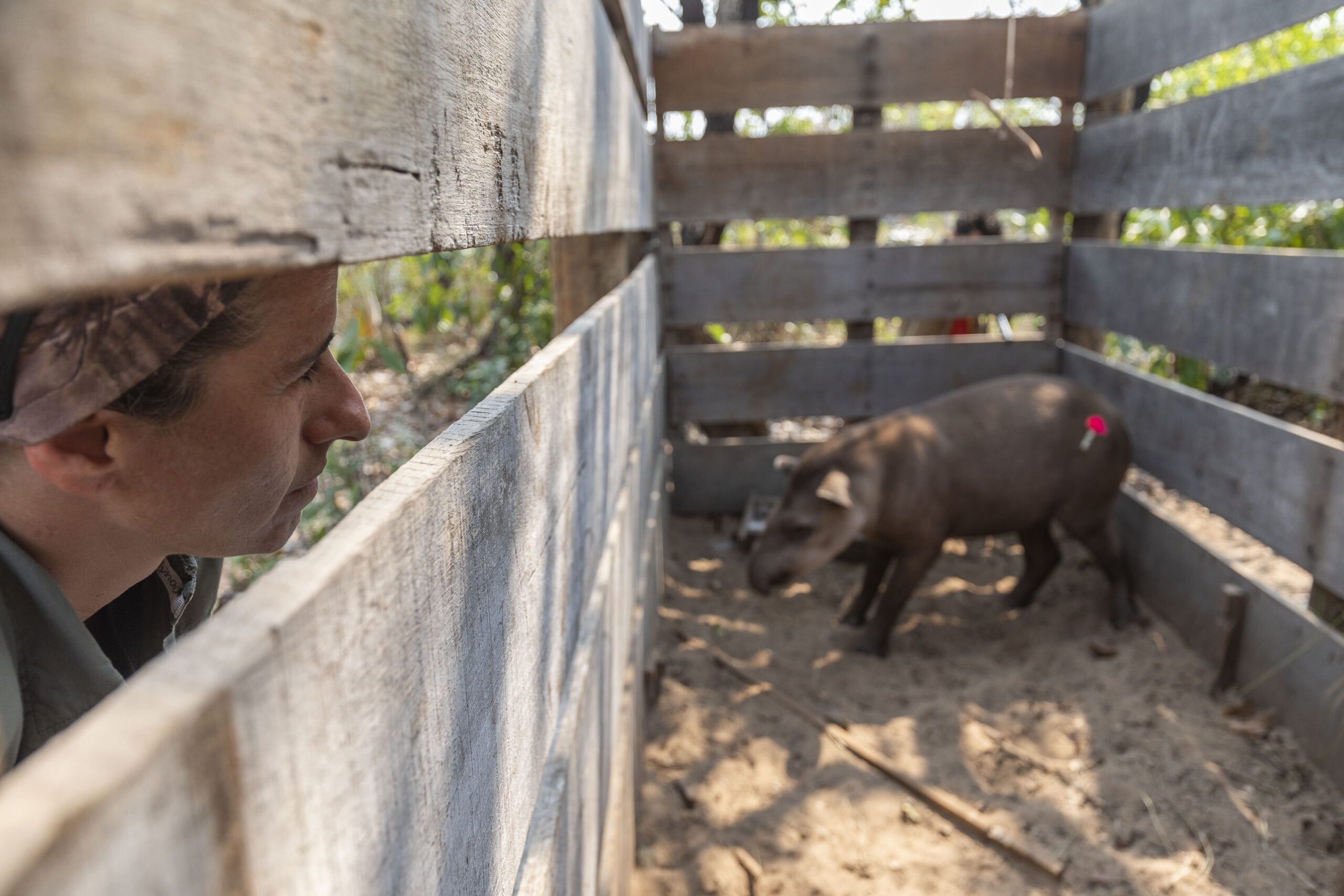
For 10 years, in the Atlantic Forests, researchers compared forests used by herbivorous mammals, including the lowland tapir (Tapirus terrestris) and the white-lipped peccary (Tayassu pecari), and areas in which these animals have been barred from access due to exclosure plots (fences). The main conclusion is that the areas used by these herbivores show lower loss of diversity than fenced areas.
The new study on tropical forests has generated an article recently published in the Journal of Applied Ecology of the British Ecological Society (BES). The research was performed at Morro do Diabo State Park, in the far west of the state of São Paulo. The work warns of the importance of conservation of animals that are facing extinction. The lowland tapir, for example, is classified as Vulnerable in the IUCN (International Union for Conservation of Nature) Red List throughout its distribution range. The white-lipped peccary, in turn, is listed as Critically Endangered in the Atlantic Forest.
Patrícia Medici, coordinator of the Lowland Tapir Conservation Initiative (LTCI) at IPÊ (Institute for Ecological Research), authors the article alongside Nacho Villar, a researcher of the NIOO-KNAW Dutch Institute for Ecology. “In this study, we recorded the results of a first experiment on the effects of conservation and protection of large herbivores on the maintenance of biodiversity in tropical forests and, to the extent we know, in any other forest biome. The study shows that large herbivores play an important role in the deceleration of the loss of forest diversity”, says Medici.
According to the study, mature forests with great diversity were those that benefited the most from the presence of large herbivores. “The results show how forest composition is severely affected when the animals are excluded from the biome, a sign of what may be happening in a series of other fragments of the Atlantic Forest, one of the most endangered biomes on the planet,” points out the researcher.
With the launching of the Decade on Restoration of the United Nations (2021 -2030), the results of this study also serve as guidance for future initiatives on forest conservation and restoration. “Conservation of these animals and trophic rewilding (without human participation) are gaining momentum as important tools to restore forest ecosystems and avoid the acute effects of global changes on biodiversity. However, such nature-based solutions are not yet recognized as a conservation option, especially in tropical forests. We believe that this study strengthens the strategic aspect of following in this direction,” points out the researcher.
Such findings demonstrate that species conservation and the restoration they promote may be more efficient in protecting against strong declines of diversity in the long run, particularly in well preserved tropical forests with high levels of forest diversity. “Throughout the 10 years of the study, the abundance of plants in the initial stage of germination, their recruitment and species richness fell by some 20% or more, providing a unique natural experiment to test the functional significance of large herbivores to avoid the collapse of biodiversity in the long run,” says Medici.
Researchers also observed whether large herbivores have a different effect on mature and secondary forests. “This is an important question and has not yet been explored in trophic rewilding. In secondary forests, we identified ca. half the number of species when compared with mature forests. In secondary forests, the results show limited protection by large herbivores against the loss of diversity. Long-run regional environmental changes place the restoration of such secondary forests at risk, and their transition to more mature and diversified forests,” says Nacho Villar.
Details of the research in practice
The discoveries are the result of monitoring 200 m2 of Atlantic Forest in Morro do Diabo State Park, São Paulo, Brazil, between 2004 and 2014. “We studied the potential role of large herbivores against the collapse of plant diversity through time, examining their effect on the abundance of plants in the initial phase of germination, as well as species richness and diversity, the temporal diversity and the rate of change of forest composition. These animals contribute directly to the plants in the forest understory, through seed dispersal and how they affect plants in the early phase of germination. Thus, biodiversity strongholds are highly sensitive to the disappearance of animals like the lowland tapir (Tapirus terrestris) and the white-lipped peccary (Tayassu pecari), for example,” explains Villar.
Medici’s team established 200 plots in the monitored area, including 100 fenced plots to prevent the access of large herbivores, and 100 control plots, where there was no restriction to the entry of the animals. In order to understand the possible differences in the maturity of the forest, the fenced areas were divided into two large groups, being 25 pairs in areas of mature forest, and 25 pairs in secondary forest.
For insulation of the areas (exclosure plots), the researchers used wooden posts and poultry netting (2×2 cm). The exclusion areas had the following dimensions: 3 meters in width, 6 meters in length, and 1.20 meter in height. A 20 cm opening was maintained along the bottom of the plot, allowing for the entry of small terrestrial mammals, such as rodents and marsupials. Within the exclosure plots, a central sampling area of 1×4 m was established, and it was divided into four 1×1 m quadrants.
Control plots that were not fenced were 1 m wide and 4 m long, divided into 4 quadrants of 1×1 m. For each exclosure and control plot, each of the 1×1 m quadrants was chosen randomly for sampling throughout the study.
Forest sampling
In the monitored quadrants, all plants with a diameter of over 10 cm and diameter ≤ 5 cm were marked with PVC tags and received reference numbers. This methodology permitted the subsequent sampling of the same individuals. New plants that germinated during the study and complied with the criteria were incorporated into the monitoring protocol.
Throughout the first five years of the study (2004-2008), the researchers measured the plants twice a year, in the early rainy season (October) and in early dry season (April). From 2009 to 2012, data collection took place once a year. The final measurements took place in 2014, ending 10 years of data collection, with a total of 14 measurements. “We followed the fate of 7,287 plants and traced the decline of diversity over 10 years,” points out Medici.
Threats and opportunity
The conservation of large herbivores and the restoration of forests affected by them, especially tropical forests, is a challenge due to a series of threats that these animals face. According to the researchers, advances in this direction must consider measures for species protection. “Effective management of the landscape, protection and conservation aimed at increasing the populations of these animals and the facilitation of dispersal and movement between remaining forest areas are strategic. Furthermore, it is worth pointing out the need for reintroduction and translocation initiatives, given that large extensions of mature forest, rich in diversity, are currently being deprived of these animals due to hunting, roadkill and so many other threats.”
Based on the results, the researchers point out that the active restoration of neotropical forests with large herbivores may, in fact, be the most efficient solution to improve the state of conservation of many species of large herbivores, contributing to the diversity of tropical forests in the long run. “We suggest that the measures begin in mature forests and then proceed to secondary forests with high levels of diversity.”
::/introtext::
::fulltext::::/fulltext::
::cck::896::/cck::