

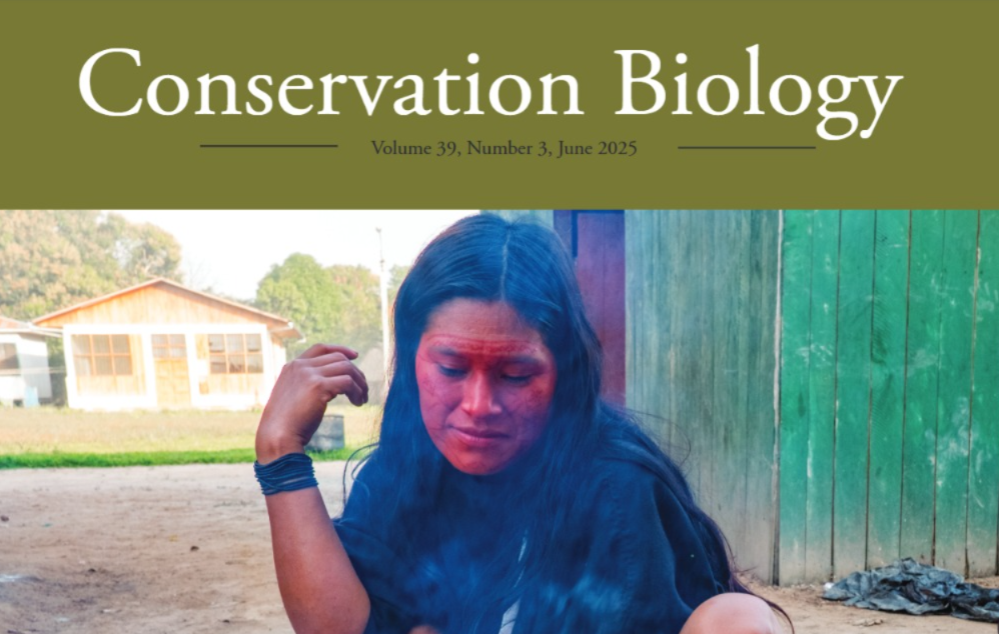
Science focused on people and nature is the focus of the May issue of the journal Conservation Biology, which features 13 articles exploring different aspects of the topic in Brazil.
The guest editors of this special issue are researchers and professors from IPÊ, in collaboration with a researcher from University College London (UCL). In their opening text, the authors highlight Brazil’s important role in changing the science of species conservation worldwide, as research started to consider communities as necessary and essential stakeholders in the process.
“We are honored to open this special issue by discussing a topic important to IPÊ: social participation in conservation initiatives. The Institute’s remarkable results in species conservation and landscape restoration over more than 30 years stem from the understanding that, without this, projects are subject to discontinuation because they fail to align with the ideals of the people who live in areas that require conservation but depend on it for their survival. This sense of belonging and collaboration among everyone is fundamental”, explains Rafael Moraes Chiaravalloti, one of the authors, professor at UCL and IPÊ school ESCAS, and researcher associated with the Institute.
In the text, the authors note that people-centered conservation programs emerged in various forms, for example, from social movements such as the Amazon Rubber Tapper Movement and the creation of sustainable use protected areas. “Linking conservation to broader social forces, many groups fighting deforestation have formed in community centers created for political education rooted in socialist ideas (e.g., the Comunidade Eclesiana de Base)”.
In addition to the Amazon, researchers also highlight the forest and agroforestry restoration program in the state of São Paulo, led by IPÊ. “Together with members of the Landless Workers’ Movement (Movimento dos Sem-Terra – MST), they created one of the most successful community restoration projects on the planet. Thousands of forest hectares were restored, hundreds of families now benefit from agroforestry products, and endangered species in the region, such as the black lion tamarin (Leontopithecus chrysopygus), are steadily recovering. IPÊ replicated the same approach in other parts of the country and became one of Brazil’s most important conservation NGOs.” Examples like these helped shift conservation biology from a science focused solely on nature to a science focused on socio-environmental change.
“In this special issue, our goal is to promote understanding of how community-centered conservation can become a central and effective aspect of conservation science and practice, and how such conservation efforts, grounded in Brazil, can be expanded and applied in other regions worldwide. One of the main themes of this special edition is to reveal how the partnership between local ecological knowledge and scientific knowledge is the root of people-centered conservation,” says the text, written by Claudio Padua (rector of ESCAS and coordinator of bioeconomy at IPÊ), Rafael Morais Chiaravalloti (professor at ESCAS-IPÊ and University College London), Fabio Scarano (advisor at IPÊ and member of the Institute of Biology at UFRJ) and Thais Q. Morcatty (University College London, London and Research Network on Diversity, Conservation and Use of Amazonian Fauna).
Access to articles: https://conbio.onlinelibrary.wiley.com/toc/15231739/2025/39/3