
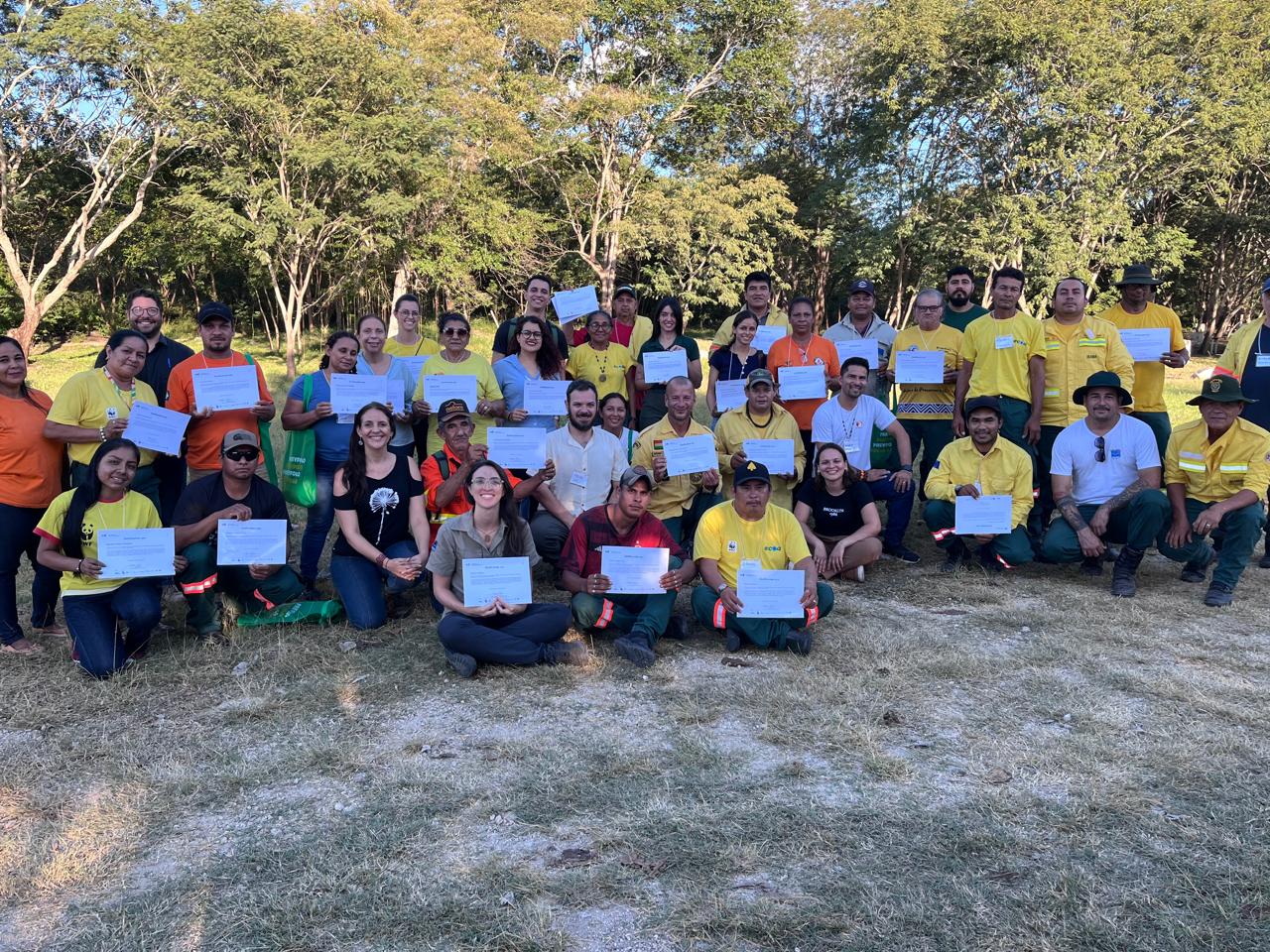
To support the work of community brigades in the Pantanal, the project United for Pantanal: strengthening voluntary and community participation in Integrated Fire Management carried out training with community brigades in the Pantanal of Mato Grosso do Sul between May 13th and 15th, in the Municipal Environmental Protection Area (APA) Baía Negra, in Ladário/MS.
Two preparatory events preceded the training. The first workshop, which assessed the performance of these brigades, took place in February. The second workshop, which focused on planning Integrated Fire Management (IFM) activities, took place in March. Last week’s meeting brought together 44 representatives from 13 community brigades in the region, as well as professionals from 10 public and private institutions working with IFM in the Pantanal.
“Our work in the Pantanal is to gather more information about community fire brigades, expand the articulation of these initiatives with public authorities such as Ibama, ICMBio, and the Fire Department, and work primarily to strengthen prevention efforts. It’s crucial that community fire brigades are better prepared to respond to forest fires near or within their communities, so they can work safely and collaboratively, improving conservation outcomes,” explains Angela Pellin, project coordinator at IPÊ, leading United for Pantanal.
Drive key application simulation
In this third meeting, participants carried out a simulation of the application of the activation key built collectively with the community brigades and other institutions that deal with Integrated Fire Management in the Pantanal, as well as training in the use of applications for monitoring hotspots and sharing geographic information for precise location and reporting of incidents.
André Luis Siqueira, Director of Programs and Projects at ECOA, says that since 2006, he has seen volunteer and community brigades as a strategy to reduce and transform the impacts caused by fires each year within the biome. “Through the federal strategy, IPÊ was already discussing volunteer and community brigades as a public policy. We monitored and became involved in this process, which is now consolidating in practice. The United for Pantanal Project brought a new level of discussion regarding the brigades. Beyond the focus on emergency responses we’ve been working on, providing equipment and training so the brigades could defend their territories more efficiently and safely, the project took this discussion to a new level, creating deeper insights, universalizing information, defining key triggers, bringing institutions together, and expanding actions.”
For Leonida Souza, leader of the Barra de São Lourenço Community Brigade, participating in the training helped establish goals and strategies to defend not only the community but also all the biodiversity present in the biome. “As a brigade, we’re not just protecting our lives, but an entire ecosystem, which is our Pantanal. “I can’t even express how important the Pantanal is to our lives, because it’s not just animals, water, and people; it’s also full of life. We live within the Paraguai River Basin, so the fact that we’re a brigade to protect this place is something that moves me deeply.”
Incident Command System
Thainan Bornato, an environmental technician with Prevfogo/IBAMA in Corumbá, Mato Grosso do Sul, emphasizes that technology and environmental education training are essential to improving the effectiveness of firefighting efforts. “Community fire brigades can prevent fires from becoming large-scale and making it more difficult to fight them. Having trained people to take part in prevention, so they can talk to community members and make that initial identification, we ensure that fires are smaller and less aggressive.”
João Paulo Pereira Santos Júnior, a sergeant in the Mato Grosso do Sul Fire Department, emphasizes the importance of training like this to improve integration between community brigades and other institutions involved in fighting forest fires. “Community brigades are the ones who know the area, know the terrain best, and are often the first to arrive on the scene, carrying out the first firefight or informing Ibama/Prevfogo or the Fire Department about the need for resources and support.”
PSA Brigades
At the event’s closing, legal, management, and fundraising aspects for these groups were presented, enabling them to participate in decision-making and fundraising. Finally, Letícia Walter, a civil servant from the State Secretariat of Environment, Development, Science, Technology, and Innovation (SEMADESC), presented the call for proposals for Payment for Environmental Services for fire brigades. According to Letícia, “PSA Brigades aims to foster the establishment of local brigades in areas of the Pantanal of Mato Grosso do Sul that are highly susceptible to fire, integrating preventive, educational, and first response actions. We identified the need to support shared governance of fires in the Southern Pantanal by focusing on those who actually work in the area.”
Next steps
The next step of the project will be to consolidate the information gathered throughout the project and provide feedback to participants. By the end of June, the project will donate equipment to community fire brigades, including Personal Protective Equipment (PPE) and tools for fighting wildfires, such as fire extinguishers, blowers, and backpack pumps. The selected brigades will be selected by IPÊ and project partners based on the information gathered throughout the process.
The Juntos pelo Pantanal project is implemented by IPÊ – Institute of Ecological Research, in partnership with Ibama/Prevfogo, ICMBio – CMIF, Fundo Casa Socioambiental (Socio-Environmental House Fund), and ECOA (Ecology and Action). Funding is provided by the Global Environment Facility (GEF) under the Conservation, Restoration, and Management Strategies for the Biodiversity of the Caatinga, Pampa, and Pantanal Project (GEF Terrestre). This project is coordinated by the Ministry of Environment and Climate Change (MMA), with the Inter-American Development Bank (IDB) as the implementing agency and the Brazilian Biodiversity Fund (FUNBIO) as the executing agency.