
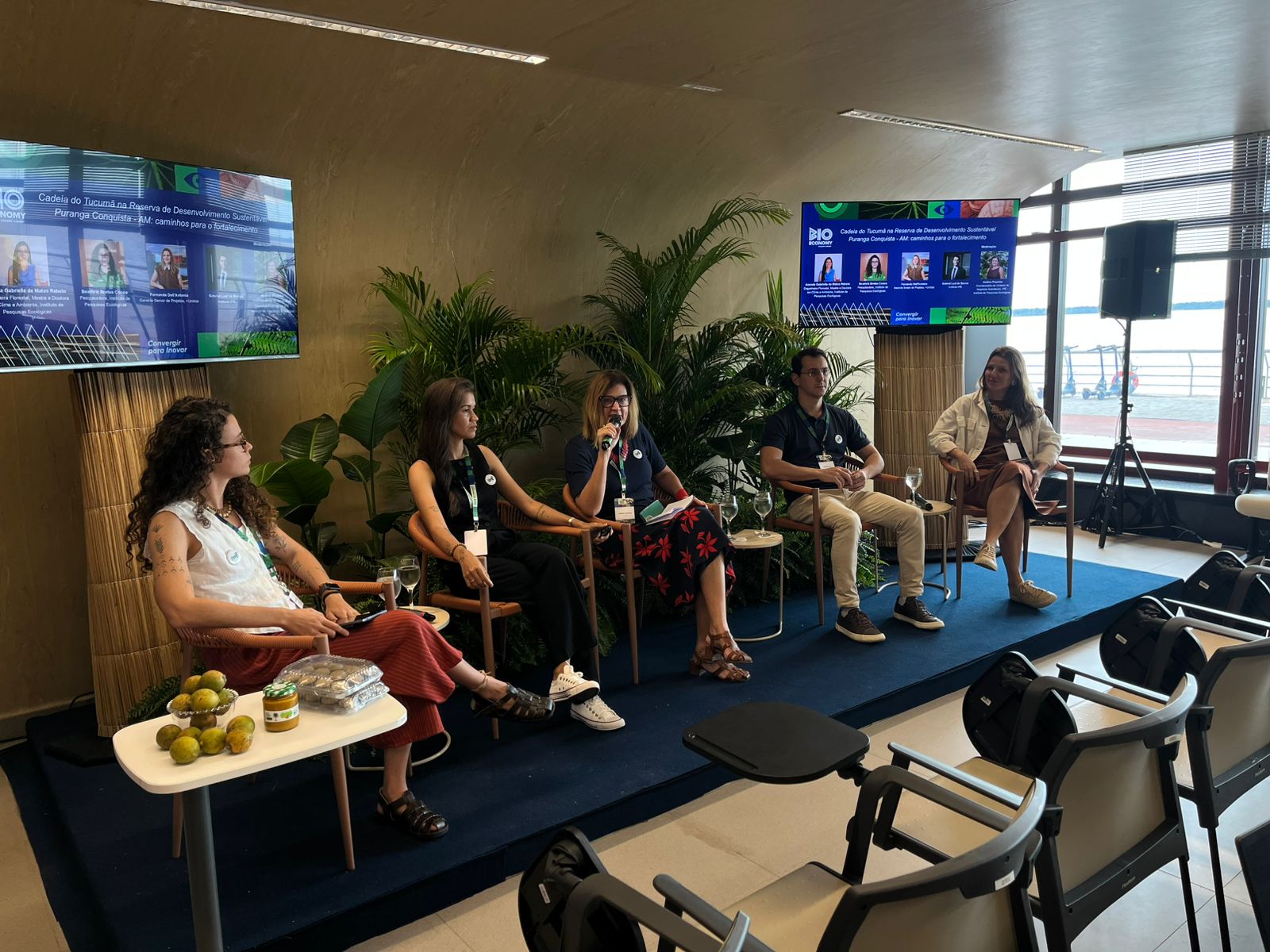
Held from May 12 to 14 in Belém, Pará, the Bioeconomy Amazon Summit convened stakeholders interested in sharing solutions, accelerating businesses, and catalyzing innovation. The event serves as a hub for convergence, connecting science, traditional knowledge, economics, and corporate decision-making, grounded in the understanding that halting biodiversity loss requires changes in business models
Value Chain
Among the invited panelists were Andrea Peçanha, Coordinator of IPÊ’s Sustainable Business Unit; Ananda de Matos Rebêlo, Extension Officer at IPÊ; Gabriel Leal de Barros, IPÊ Board Member; and Beathriz Cocco, IPÊ researcher currently conducting a study on how to add value to tucumã (Astrocaryum aculeatum G. Mey.) and thereby contribute to biodiversity conservation. The applied research project is Beathriz Cocco’s final thesis for the Professional Master’s Program in Biodiversity Conservation and Sustainable Development at ESCAS, which is currently accepting applications.
Although tucumã fruits are highly valued in regional cuisine and are part of Amazonian cultural identity, the species has the potential to contribute even more to forest conservation. To better understand the main challenges and opportunities for progressing in this direction, Beathriz conducted more than 60 surveys among three groups: residents of the Puranga Conquista Sustainable Development Reserve (RDS), located in Manaus, Amazonas, who are already engaged in tucumã production; people interested in producing it; and value-chain actors such as processors.
“Based on the responses, I developed a socioeconomic profile of the participants and gathered information on production volumes, how, when, and to whom they sell, the prices obtained during the previous year, as well as data on organization, commercialization channels, and future perspectives. With value-chain actors, I identified demand for the fruit during both harvest and off-season periods, their sources of supply, commercialized volumes, and the quality standards they seek,” explains Beathriz.
The consolidated results have already made it possible to establish the socioeconomic profile of community members, assess commercialization channels, and better understand the structure and stakeholders involved in this value chain.
The research is ongoing and includes the following planned deliverables:
- A thesis presenting the analysis and discussion of collected data, along with recommendations for community members on strengthening the value chain through value addition;
- A guide to contacts and best practices designed to shorten commercialization channels between community producers and processors
“The opportunity to present the study results at BAS was highly valuable. Over the course of three days, I was immersed in discussions on bioeconomy, attending panels, workshops, and roundtables focused on positioning traditional peoples as key actors within socio-biodiversity value chains. It was a very insightful experience and will certainly broaden my perspective when developing recommendations and discussing opportunities with the Puranga Conquista Sustainable Development Reserve,” the researcher adds.