

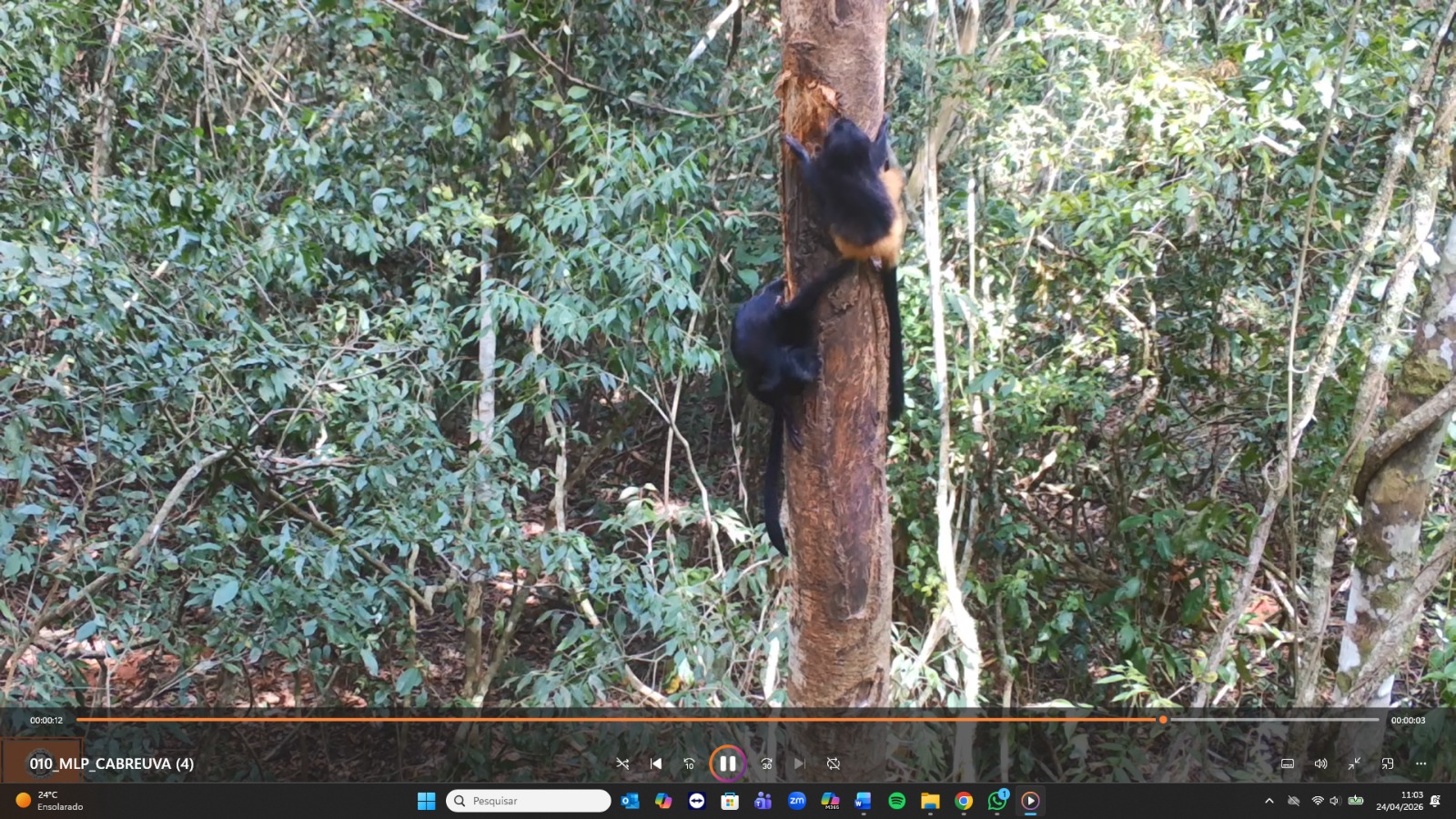
For the first time, researchers have documented the development of black lion tamarins (Leontopithecus chrysopygus) from birth through the first months of life – the period considered most critical for their survival. Using arboreal camera traps installed in the understory of the Atlantic Forest in western São Paulo, scientists recorded a newborn infant during its first two months and followed another individual from infancy to the subadult stage. The findings were published in the International Journal of Primatology and provide unprecedented insights into the life history of one of the world’s rarest primates.
The study, led by researchers from IPÊ’s Black Lion Tamarin Conservation Program, analyzed more than 1,300 mammal records collected between 2020 and 2024 from 27 cameras placed between 0.5 and 8 meters above the ground. Around 130 records corresponded to black lion tamarins. According to first author Daniel Felippi, the ability to monitor young individuals without disturbing them offers valuable information about survival during the earliest stages of life while avoiding stress associated with more invasive monitoring techniques.
Innovation high in the forest
Although camera traps are widely used on the forest floor, their application in the understory and canopy remains relatively uncommon. By targeting key resources used by black lion tamarins – such as tree cavities, artificial nest boxes, feeding platforms, and important tree species – the research team demonstrated that arboreal cameras can provide an effective, non-invasive tool for monitoring both population structure and behavior.
“Our cameras gave us a unique perspective of these forests from above,” said Gabriela Rezende, coordinator of the Black Lion Tamarin Conservation Program. “Beyond black lion tamarins, we were able to observe how different species share resources and adapt their behavior in fragmented landscapes. These results reinforce the idea that protecting a flagship species helps safeguard entire communities of wildlife.”
In addition to black lion tamarins, the cameras recorded six other arboreal mammal species, including capuchin monkeys, opossums, woolly opossums, squirrels, and southern tamanduas. Several of these species were observed using artificial nest boxes originally installed for black lion tamarins, highlighting the broader ecological benefits of conservation interventions.
Understanding life in the Atlantic Forest understory
The study also revealed patterns of activity and resource use among the mammals inhabiting these forests. Black lion tamarins showed two peaks of activity – one in the late morning and another in the late afternoon – and relied heavily on natural tree cavities, which emerged as important shared resources for multiple species.
Conducted in Morro do Diabo State Park and Fazenda San Maria, two key sites for black lion tamarin conservation, the research highlights the value of combining innovative technologies with long-term field studies. As the Atlantic Forest retains only a fraction of its original cover, these new tools are helping scientists better understand how species adapt to fragmented habitats and how conservation actions designed for one endangered primate can benefit entire ecosystems.