

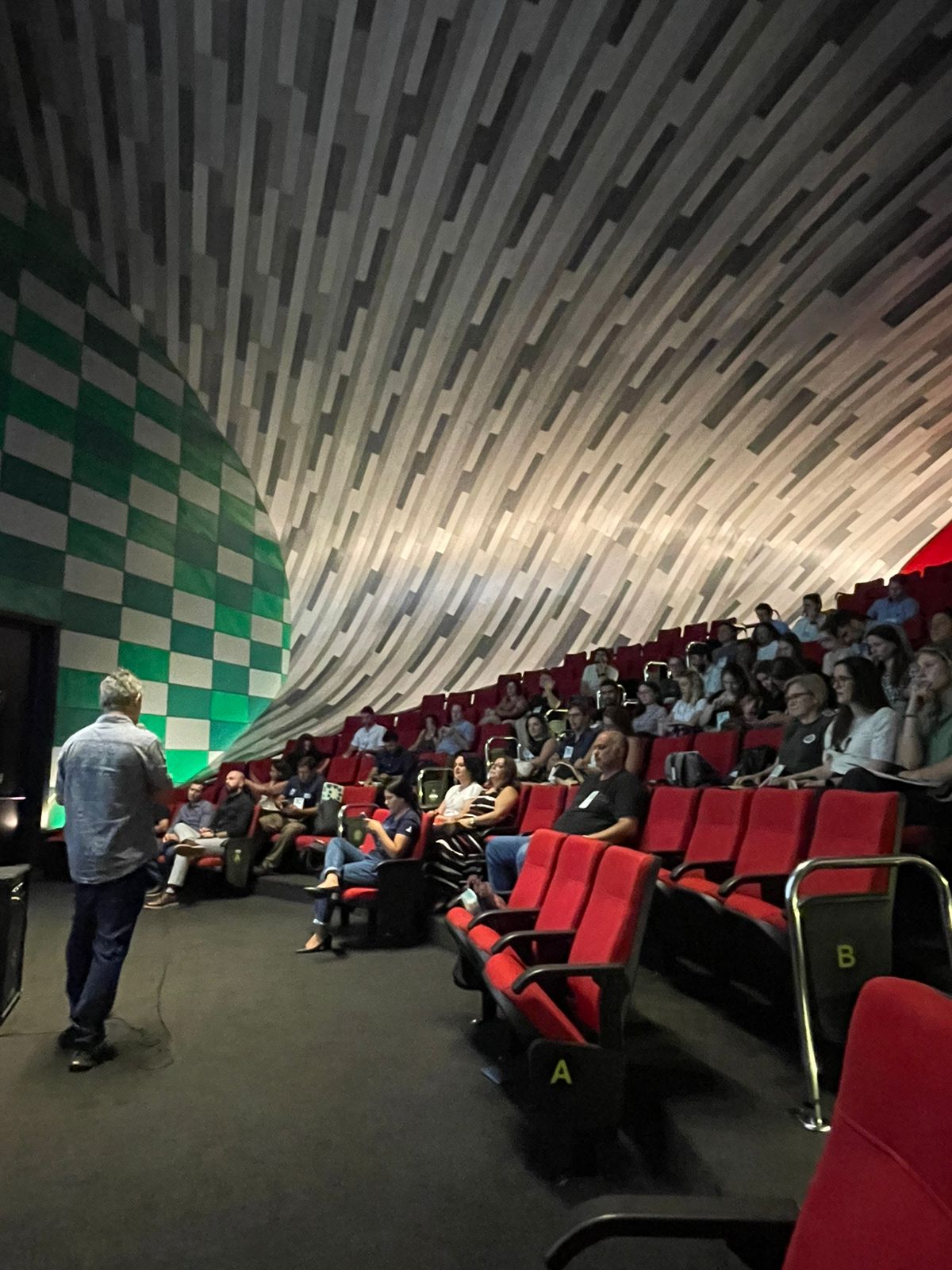
After the success of the first and largest forum on conservation, sustainability and appreciation of the Pantanal held in August 2023, in Campo Grande, the Pontes Pantaneiras coalition announces a new meeting in the city: the Pontes Pantaneiras Laboratory. This time, the group will bring experts to reflect on the paths and actions on various topics for the Pantanal. The event will be led by the Universidade Colégio de Londres (UCL) and will take place on the 6th, 7th and 8th of May, at the Federal University of Mato Grosso do Sul, in Campo Grande (MS). IPÊ is among the event organizers.
The opening panel bridges Science, Public Policies and Conservation actions in the Pantanal, and will be led by the professor at the UFMS Biosciences Institute, Fábio Roque. The event’s seminar discussed the New Pantanal Law. The topic features a presentation by Arthur Falcette, executive secretary of the Environment – SEMADESC, who discusses interactions and challenges between riverside dwellers and animals that live in the region and their health implications.
“Being able to bring together these important actors to talk about the conservation of the biome shows credibility and the strength of the participatory process as a basis for creating solutions that will impact the future of one of the most preserved biomes in the world”, says Rafael Chiaravalloti, professor at the University College of London and coordinator of the Pontes Pantaneiras Laboratory. Rafael is also a researcher associated with IPÊ and professor at ESCAS – Escola Superior de Conservação Ambiental e Sustentabilidade, IPÊ’s main educational front.
As a strategy for a collaborative dynamic, participants will be allocated into six groups to discuss themes of restoration, wildlife, fishing, protected areas, ecotourism and livestock. The organizers of the Laboratory will act as dialogue facilitators and will contribute to the exchange of information that each individual can promote, according to their role and influence in the ecosystem.
The groups must answer questions such as: “What do scientists offer or can they offer to the public authorities? What does the public authorities expect from researchers who work in the Pantanal? How is it possible to operationalize this contribution and what is needed for it to happen?” At the end of the event, these questions will be answered so that a path can then be taken towards the development of environmental conservation actions.
The Pontes Pantaneiras Laboratory is carried out by the institutions Universidade Colégio de Londres (UCL), IPÊ – Ecological Research Institute, Smithsonian, Embrapa Pantanal and the Federal University of Mato Grosso do Sul. Its institutional supporters are Ágora, Fazenda Barranco Alto, Economic and Social Research Council (ESRC), PPBio/Pantanal UFMS and Bioparque Pantanal and financial support from UCL and Pew Charitable Trusts.
A place called Pantanal: (Re)discovering the smallest biome in Brazil
On the first day, the book Um lugar chamado Pantanal (A Place Called Pantanal), by Teca Botelho, will also be launched, containing information on the Pantanal biome and mixing humor and knowledge. The writer has a degree in Biological Sciences and a master’s degree in Biodiversity Conservation and Sustainable Development from ESCAS – Escola Superior de Conservação Ambiental e Sustentabilidade, the main educational front of IPÊ – Instituto de Pesquisas Ecológicas.
The book addresses themes related to fauna, flora, landscapes, the relationship with fire, threats and challenges, in addition to reporting experiences lived by the author on her field expeditions.